
Building software is one thing. Proving it can handle real-world traffic is something entirely different.
Recently, I completed the first serious load testing session for the headless e-commerce SaaS platform I'm building, RootDock. While architectural diagrams, code quality, and scalability patterns are important, they remain assumptions until they are validated under actual load.
The Illusion of Scalability
As software architects and developers, it's easy to believe a system will scale because:
- The architecture follows best practices
- The codebase is clean and maintainable
- The infrastructure is designed for growth
- The database is properly indexed
- The application is containerized and cloud-ready
However, none of these guarantees performance under sustained traffic.
Real validation begins when a system faces thousands of requests, competing workloads, and the unpredictable behavior of real users.
The Test
To establish a performance baseline, I selected one of the platform's core APIs: product search.
The goal was straightforward:
Can the platform maintain stable performance under continuous load without errors or significant degradation in response times?
The test was executed using k6, targeting the product search endpoint under sustained traffic conditions.
Technology Stack
- Java
- Spring Boot
- PostgreSQL
- Docker
- k6
Results
The outcome was encouraging:
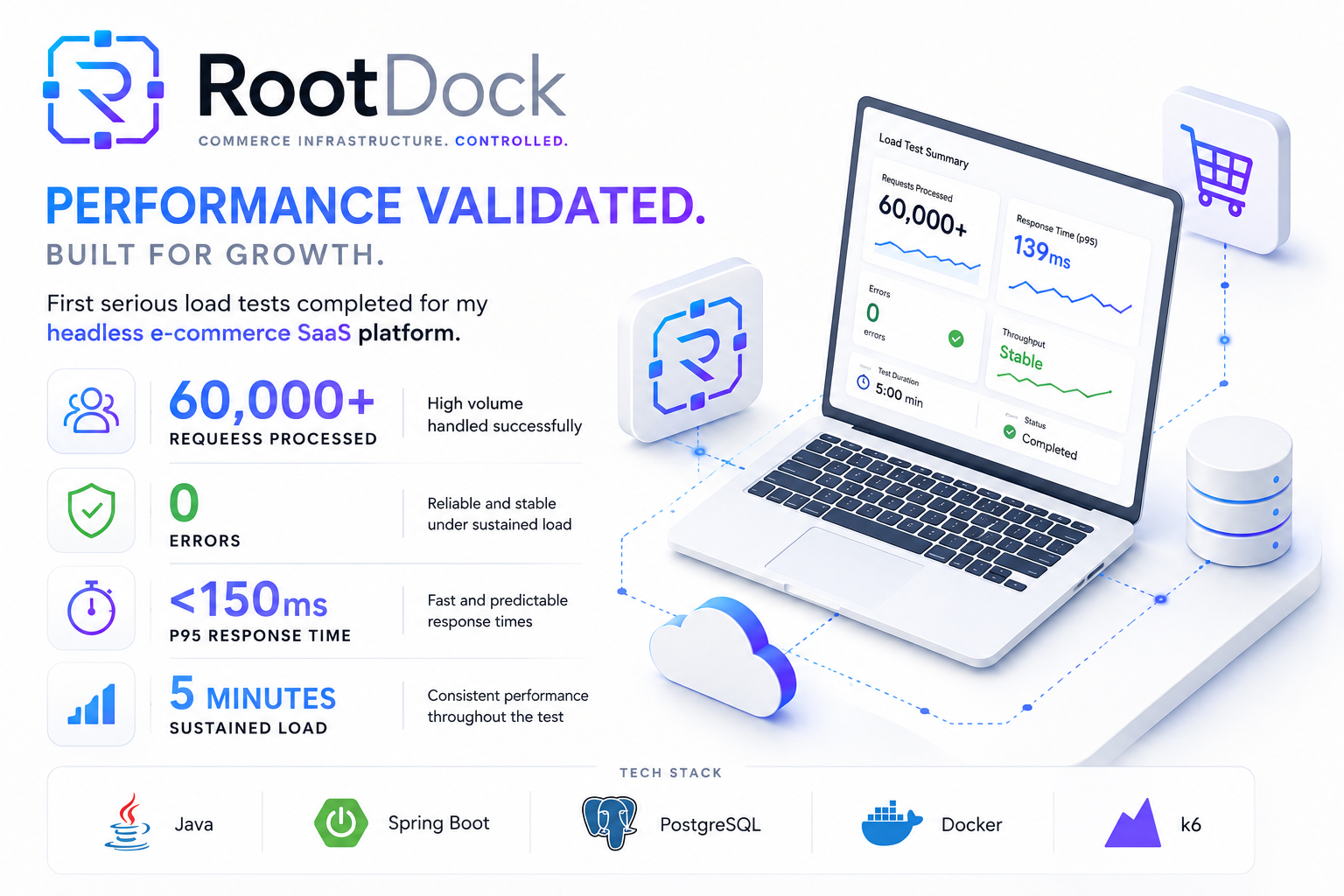
- More than 60,000 requests processed
- Zero errors during the test
- Consistent sub-150ms p95 response times
- Stable performance throughout a sustained 5-minute load test
While the numbers themselves are useful, they were not the most valuable part of the exercise.
What Load Testing Really Provides
Performance testing is often viewed as a way to measure speed.
In reality, its greatest value is confidence.
Load testing transforms assumptions into measurable facts.
It answers questions such as:
- Can the architecture support expected growth?
- Where do bottlenecks begin to appear?
- How does the system behave under sustained pressure?
- Which components deserve optimization effort?
- Are infrastructure resources being used efficiently?
Without load testing, these questions remain theoretical.
With load testing, they become data-driven decisions.
Discovering Bottlenecks Early
One of the most important outcomes of performance testing is identifying constraints before customers encounter them.
Every system has limits.
The objective is not to build a platform with infinite capacity.
The objective is to understand where those limits are, why they exist, and how to move them when growth requires it.
Finding a bottleneck in a controlled environment is significantly better than discovering it during a marketing campaign, a product launch, or a seasonal traffic spike.
Architecture Validation
For me, this milestone was less about achieving a specific throughput number and more about validating architectural decisions.
Every layer of the platform contributes to overall performance:
- API design
- Database access patterns
- Connection pooling
- Query optimization
- Infrastructure configuration
- Application threading model
Load testing provides objective feedback on whether those decisions are working together as intended.
The Journey Continues
This test represents an important milestone, but it is only the beginning.
As the platform evolves, additional testing scenarios will include:
- Multi-tenant workloads
- Larger product catalogs
- Concurrent customer activity
- Order processing flows
- Checkout and payment integrations
- Horizontal scaling validation
Performance is not a one-time achievement.
It is an ongoing engineering discipline.
Final Thoughts
Clean code is valuable.
Good architecture is essential.
But real confidence comes from validation.
There is something deeply satisfying about seeing real-world data confirm that the direction you're taking is the right one.
Every successful load test brings a platform one step closer to production readiness and one step closer to earning customer trust.
And in the end, trust is what scalable systems are really built on.
Build on a Validated Platform
RootDock is engineered for growth — measurable performance, clean APIs, and architecture proven under load.