
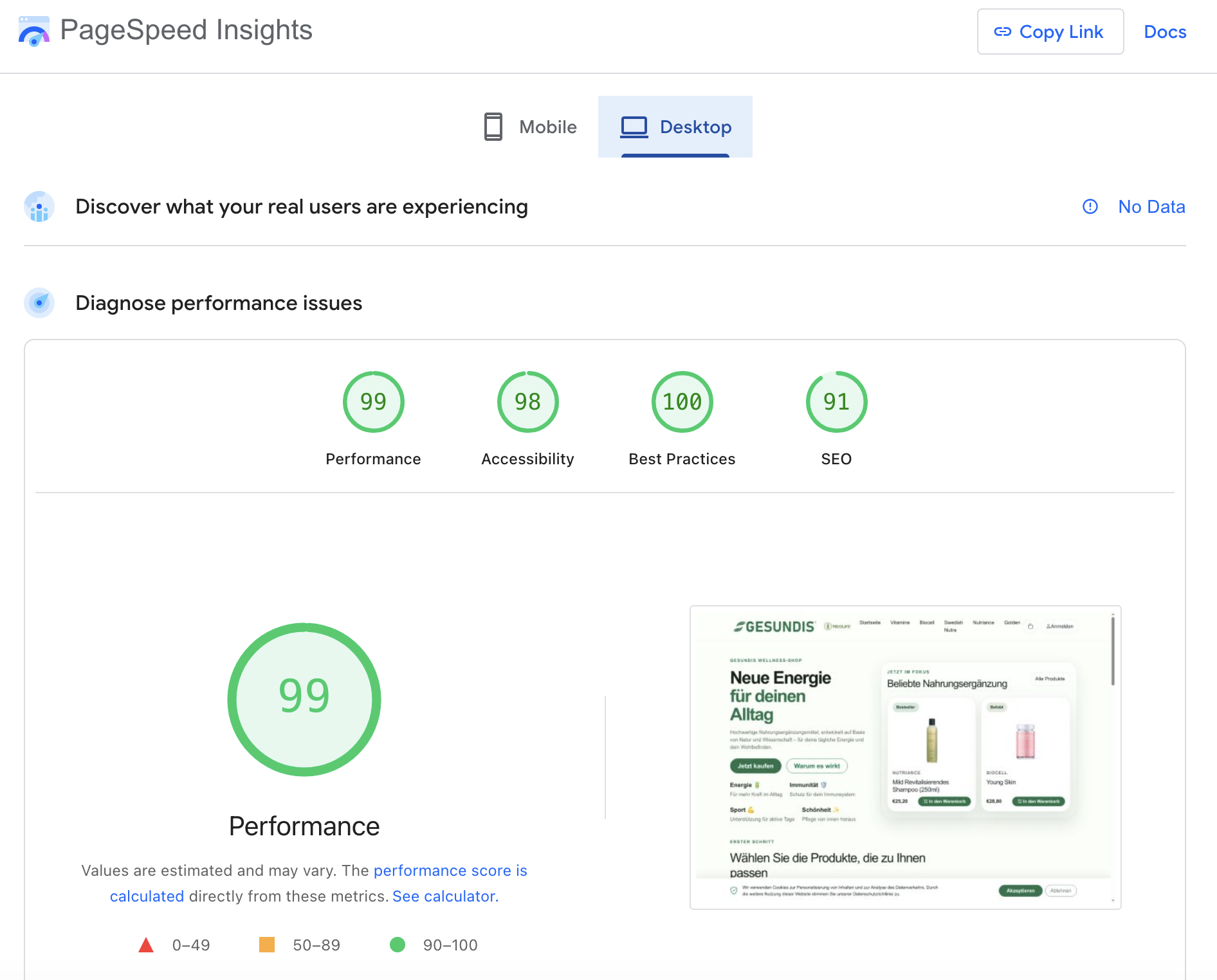
Modern eCommerce websites are often slow, overloaded with plugins, and difficult to optimize. Many businesses accept poor performance as normal because traditional platforms introduce too many layers, scripts, and unnecessary complexity.
But it does not have to be this way.
Recently, we launched a real production storefront that achieved 99+ PageSpeed Insights scores on both mobile and desktop, without using performance magic, hidden optimizations, or lightweight demo tricks.
The entire project was built using a custom frontend connected to the RootDock API.
And the most important part: this was not a fake benchmark environment.
It was a fully working production eCommerce platform with real products, real business logic, and real customer workflows.
The Problem With Traditional eCommerce Platforms
Most eCommerce systems become slow for the same reasons:
- too many plugins
- large monolithic themes
- unnecessary JavaScript
- poor API architecture
- excessive third-party integrations
- frontend code that developers cannot fully control
Over time, stores become difficult to maintain and even harder to optimize. Teams start fighting symptoms instead of solving the real architectural problems.
This usually leads to:
- poor mobile experience
- lower SEO rankings
- reduced conversion rates
- slower checkout flows
- expensive infrastructure costs
Why API-First Architecture Changes Everything
The biggest advantage of modern headless commerce is separation of concerns.
With an API-first backend and custom frontend:
- the backend focuses on business logic
- the frontend focuses on user experience and speed
- developers gain full rendering control
- unnecessary assets can be removed completely
This creates a much cleaner and more predictable performance model. Instead of trying to optimize a massive monolithic system, developers can build exactly what the storefront needs and nothing more. That is exactly what we did with RootDock.
No Hidden Tricks
There were no artificial optimizations used to manipulate PageSpeed scores.
No:
- fake static pages
- disabled features
- benchmark-only configurations
- hidden caching tricks
- stripped-down demo content
The store included:
- real product data
- API integrations
- dynamic pages
- production deployment
- responsive frontend
- SEO optimization
- modern caching strategy
The results came from good architecture decisions, not temporary hacks.
What Actually Improves Performance
High-performance eCommerce is usually not about a single optimization. It comes from many small engineering decisions.
1. Lightweight Frontend
A custom frontend avoids unnecessary code and gives full control over:
- rendering
- bundle size
- asset loading
- image optimization
- lazy loading
- component structure
2. Clean APIs
Fast APIs reduce frontend complexity and improve loading consistency.
With properly designed endpoints:
- fewer requests are needed
- payload sizes stay small
- frontend state becomes easier to manage
3. Smart Caching
Caching should be part of the architecture from the beginning, not added later as a workaround.
Good caching dramatically improves:
- TTFB
- scalability
- infrastructure efficiency
4. Modern Deployment Strategy
Infrastructure matters. Optimized hosting, CDN usage, compression, and efficient delivery pipelines all contribute to excellent performance.
Why Performance Matters More Than Ever
Website speed is no longer just a technical metric.
It directly impacts:
- SEO rankings
- user experience
- conversion rates
- mobile usability
- advertising ROI
Even small delays can reduce sales and increase bounce rates. Fast websites create trust. In eCommerce, trust directly affects revenue.
The Future of eCommerce
The industry is clearly moving toward:
- headless commerce
- API-first platforms
- composable architectures
- frontend flexibility
- cloud-native scalability
Businesses want systems that are:
- fast
- maintainable
- scalable
- customizable
Traditional all-in-one platforms struggle to deliver this efficiently. That is why platforms like RootDock focus on modern architecture from the start.
Final Thoughts
Achieving 99+ PageSpeed Insights scores is not about chasing numbers. It is about building software correctly.
With clean architecture, API-first design, and a properly optimized frontend, excellent performance becomes a natural result, not a constant battle.
No magic. Just solid engineering.
Want a Faster Storefront?
Build with RootDock and launch a production-ready ecommerce experience designed for speed and growth.