For many merchants, this means:
- New development costs
- Additional plugins and integrations
- Testing and compliance reviews
- Last-minute implementation projects
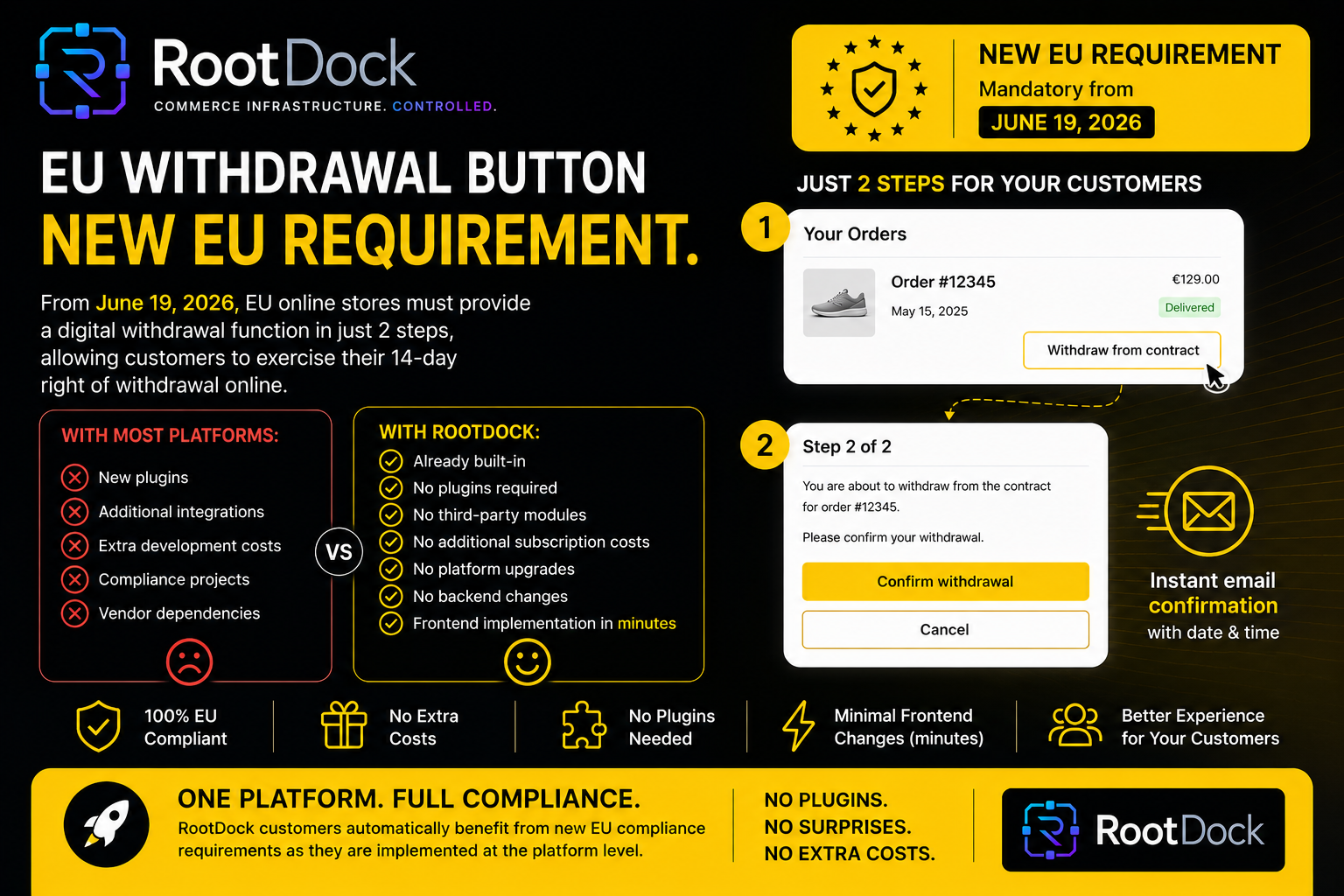
For RootDock Customers? Nothing.
While many businesses are now scrambling to plan how to comply, RootDock customers are already covered.
- Withdrawal Button support is built into the platform
- No extra fees
- No third-party plugins
- No compliance projects
- No platform migration required
- Only minimal frontend adjustments if desired
This Is Exactly Why We Built RootDock Differently
A modern commerce platform should not force merchants to chase regulations, install more plugins, or hire consultants every time a new directive is introduced.
Compliance should be part of the platform itself.
Every regulatory requirement we implement centrally becomes an automatic advantage for every RootDock customer:
- Less maintenance
- Lower risk
- Reduced costs
- More time to focus on growth
SaaS Should Get Out of the Way — Not Become the Bottleneck
A SaaS platform exists to remove friction, not to add it. But too often the opposite happens: a new business model, a new market, a new EU directive — and suddenly the platform itself becomes the blocker. Roadmap tickets, vendor lock-in, paid add-ons, migration projects.
The right SaaS should absorb change silently. Whether the trigger is a business decision (new pricing model, new country, new sales channel, new ERP, new marketplace) or a regulatory change (VAT rules, GPSR, DSA, the new Withdrawal Button), merchants should never feel it as a project. They should feel it as a toggle.
This Is Where Headless Wins
Traditional monolithic platforms tightly couple the storefront, business logic, and compliance layer. Every change — commercial or legal — ripples through themes, plugins, and custom code. That is why merchants on legacy SaaS keep paying consultants every time something shifts.
A headless, API-first platform solves this structurally:
- Business logic lives in the platform — not in the theme or in a plugin
- Compliance is implemented once, centrally, for every tenant
- The storefront stays free to evolve independently of regulation
- New channels (marketplaces, apps, AI agents, POS) plug in through the same APIs
- No forced migrations when laws or business models change
- No plugin ecosystem to audit, update, and pray won't break checkout
With RootDock, when a new EU rule lands — like the June 19, 2026 Withdrawal Button — merchants don't open a project. They keep selling. The platform already handled it.
The Future of eCommerce Is Not Collecting Plugins
The future is using a platform that is ready before regulations arrive, and flexible enough to follow your business wherever it goes next.
That is what a modern SaaS should be. That is what headless makes possible. RootDock is already there.
Stay Compliant Without the Last-Minute Scramble
Launch on a commerce platform where EU regulations are handled centrally — so your team can focus on growth, not directives.